



Font Design · VD5B
Font Designs are Master Takase's unique designs. Often she will use her own style or a combination of fonts and, without a classification limit, create exactly the look she wants.
文武両道 bunbu ryōdō Literary and Military Arts
Both ways, letters and arms.
Master Takase creates this beautiful scroll when your order is placed. Personally preparing the ink and brushing your art that proudly bears her signature and seal. This is an original work of art.
Description
Literary and Military Arts in Japanese is 文武両道 which is read bunbu ryōdō
文武両道, read bunbu ryōdō: both ways, letters and arms.
The four characters name the civil and the martial held together in one person, the sword and the pen, and they have never meant a choice between the two, only the refusal to choose. Under them is the Chinese pair 文武, which in the Analects is not two arts but two kings, Wen and Wu, the founders of Zhou, one civil and one martial by name, whose way is the balance of the two.
Japan made the pair two ways in a book of moral tales for the young, where a court keeps letters and arms as its left and right wings, and both ways in Nichiren, for whom governing is knowing when to put arms first and when letters.
The shogunate wrote the balance into the opening article of its first law for the warrior houses, and Miyamoto Musashi, the swordsman and calligrapher who is the phrase's archetype, opens the Book of Earth with his own sentence on it, in the older form two ways: a samurai is said to follow the two ways of letters and arms, and to cultivate both is the way; most samurai, he complains, take the way to mean only knowing how to die.
In a Japanese school today the phrase is praise for a student good at both books and sport. The English title is the house's own rendering; historians say the civil and military arts, and the pen and the sword, the idiom everyone reaches for, must not turn the phrase into a proverb about which is mightier.
bunbu ryōdō is composed of the kanji 文 (read bun) meaning "art; literature", 武 (read bu) meaning "military; arms; chivalry", 両 (read ryō) meaning "both; two" and 道 (read dō) meaning "the way; teachings".
We want you to be as happy with the meaning as you are with Master Takase's art. To learn more, visit Philology of 文武両道.
Delivery
Your scroll is brushed when you order it and completed within 1 to 3 business days. It ships by USPS Priority Mail from Master Takase's studio in Washington State, boxed and ready to hang, with a printed page giving the art's English, romaji and Japanese.
Sending it as a gift? Tell us when you order and we will include your message.
Shipping is calculated at checkout from your address; within the United States it is $13 to $22. We ship worldwide, and any import charges for your country are shown at checkout before you pay.
Every order is covered by our 30-day money-back guarantee. If your scroll arrives damaged, or we made an error, we replace it or refund you in full, including shipping. Refund policy
About Our Scrolls
Master Japanese Calligrapher Eri Takase brushes your scroll by hand when you order it. Each scroll bears her red seal, 英利, and her signature.


The scrolls are 12 1/4" W × 43" H (31 × 109 cm) with real silk borders and Japanese paper that are layered so the scroll hangs straight and will not warp over time. The scrolls themselves are made by Sankō (株式会社三幸) in Gifu prefecture, which has been making high quality scrolls since 1947, and we have worked with Sankō for over two decades.
Eri Takase was born and raised in Osaka, Japan, and holds the rank of Shihan, the highest rank in Japanese calligraphy, from the Bokuteki-kai and the Bunka-shodo. About Master Takase
Related products
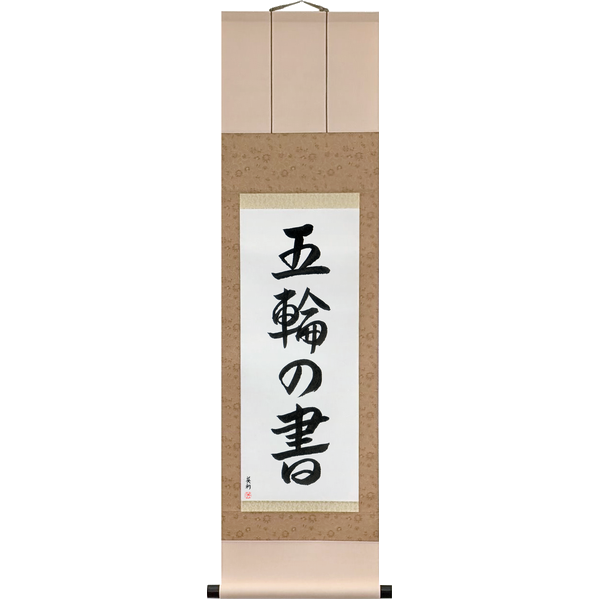
Book of Five Rings (gorin no sho)
Book of Five Rings (gorin no sho) on a traditional Japanese Scroll by Master Eri Takase.

Five Elements (chi sui ka fū kū)
Five Elements (chi sui ka fū kū) on a traditional Japanese Scroll by Master Eri Takase.

Miyamoto Musashi (miyamoto musashi)
Miyamoto Musashi (miyamoto musashi) on a traditional Japanese Scroll by Master Eri Takase.

Spirit of Battle (senki)
Spirit of Battle (senki) on a traditional Japanese Scroll by Master Eri Takase.