



Font Design · VD4A
Font Designs are Master Takase's unique designs. Often she will use her own style or a combination of fonts and, without a classification limit, create exactly the look she wants.
Miraculous Comeback
kishi kaisei
A miraculous comeback, a recovery from the brink.
Master Takase creates this beautiful scroll when your order is placed. Personally preparing the ink and brushing your art that proudly bears her signature and seal. This is an original work of art.
Description
Miraculous Comeback in Japanese is 起死回生 which is read kishi kaisei
起死回生 (kishi kaisei): a miraculous comeback, a recovery from the brink.
Literally it is to raise the dying and return the dead to life, said twice for strength, and the first character is raise, not wake. The verb belongs to the physician 扁鵲. The Records of the Grand Historian tell how the world said he could bring the dead to life, and how he answered: I cannot; this one was going to live, and I made him rise. That correction is why the word fits a recovery and not a funeral.
For a thousand years it was a doctor's praise in China: a Tang recipe blown into the nose of a dying man, a coroner's handbook of 1247 hoping its work may have the same use as raising the dead, a Ming minister's preface to the great materia medica.
The figure is at least as old as Wang Yangming, who told his students the realm was like a body wasted with long illness and they the ones to raise it, and in Journey to the West Guanyin draws the four characters as a charm in Sun Wukong's palm to revive a withered tree.
Japan's first book with the word is Nakae Tōju's of 1650, naming the four great physicians who won the merit of raising the dead, and it stayed with the court doctors for two centuries before a Meiji patent medicine wore it as a brand and Ozaki Yukio used it of the nation. The game-winning home run is the newest sense, a modern dictionary's example, not the word's origin. four-character idiom kishi kaisei is composed of the kanji 起 (read ki) meaning "raise", 死 (read shi) meaning "death", 回 (read kai) meaning "return", and 生 (read sei) meaning "life".
This beautiful art makes an excellent gift as a reminder of a great comeback victory or to remind one that where there is a will there is still a way.
Delivery
The scroll is completed within 1–3 business days and is shipped from Master Takase's studio in Washington State by USPS Priority Mail. It arrives ready to display.
The scroll is packed in its own box inside the shipping box. A printed page travels with it showing the art with its English, romaji and Japanese. Sending it as a gift? Ask us when you order and we will include your message.
The scroll is $220. Shipping is USPS Priority Mail, calculated at checkout from your address: within the United States it is roughly $13 to $22; to Canada about $47; to Europe, the United Kingdom, Japan, Australia, Korea and Brazil about $69 to $86. Outside the United States, import tax and customs charges are collected by your customs authority at delivery and are not part of what you pay us. Germany is the one exception: we collect them at checkout so nothing is owed at the door.
Every order is covered by our 100% money-back guarantee for 30 days. Contact us first and we will confirm the return details. If your item arrives damaged, or we made an error, we replace it or refund you in full, including shipping. Refund policy
About Our Scrolls
Eri Takase was born and raised in Osaka, Japan, and holds the rank of Shihan, the highest rank in Japanese calligraphy, from the Bokuteki-kai and the Bunka-shodo. About Master Takase
Master Takase personally brushes your Japanese scroll when you order. Each scroll proudly bears her red seal, 英利, and her signature.
The scrolls are 12 1/4" W × 43" H (31 × 109 cm) with real silk borders and Japanese paper that are layered so the scroll hangs straight and will not warp over time. The scrolls themselves are made by Sankō (株式会社三幸) in Gifu prefecture, which has been making high quality scrolls since 1947, and we have worked with Sankō for over two decades.
Related products
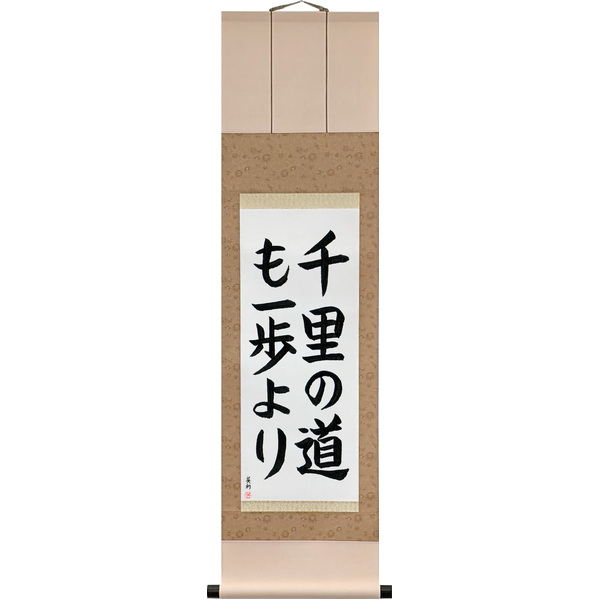
A Journey of a Thousand Miles Begins with a Single Step (senri no michi mo ippo yori)
A Journey of a Thousand Miles Begins With a Single Step in Japanese, 千里の道も一歩より, a hand-brushed hanging scroll by Master Calligrapher Eri Takase.

A New Beginning (aratana hajimari)
A New Beginning (aratana hajimari) on a traditional Japanese Scroll by Master Eri Takase.

Action Before Words (fugen jikkō)
Action Before Words (fugen jikkō) on a traditional Japanese Scroll by Master Eri Takase.

Be Prepared (sonae yo tsune ni)
Be Prepared in Japanese, 備えよ常に (sonae yo tsune ni), a hand-brushed hanging scroll by Master Calligrapher Eri Takase.